











• TRUSTED RESEARCH

    TRUSTED RESEARCH | STRATEGIC INSIGHT

    SMB. CORE MIDMARKET. UPPER MIDMARKET. ECOSYSTEM
    LEARN MORE
  • INTERWORK 2.0: THE AGENTIC FUTURE OF CONNECTED BUSINESS

    INTERWORK 2.0: THE AGENTIC FUTURE OF CONNECTED BUSINESS

  • 2026 TOP 10 SMB BUSINESS ISSUES, IT PRIORITIES, IT CHALLENGES

    2026 TOP 10 SMB BUSINESS ISSUES, IT PRIORITIES, IT CHALLENGES

  • 2026 TOP 10 SMB PREDICTIONS

    2026 TOP 10 SMB PREDICTIONS

    SMB & Midmarket: Autonomous Business
    READ
  • 2026 TOP 10 PARTNER PREDICTIONS

    2026 TOP 10 PARTNER PREDICTIONS

    Partner & Ecosystem: Next Horizon
    READ
  • ARTIFICIAL INTELLIGENCE

    ARTIFICIAL INTELLIGENCE

    SMB & Midmarket Analytics & Artificial Intelligence Adoption
    LEARN MORE
  • IT SECURITY TRENDS

    IT SECURITY TRENDS

    SMB & Midmarket Security Adoption Trends
    LATEST RESEARCH
  • BUYERS JOURNEY

    BUYERS JOURNEY

    Technology Buyer Persona Research
    LEARN MORE
  • PARTNER ECOSYSTEM

    PARTNER ECOSYSTEM

    Global Channel Partner Trends
    LATEST RESEARCH
  • CLOUD ADOPTION TRENDS

    CLOUD ADOPTION TRENDS

    SMB & Midmarket Cloud Adoption
    LATEST RESEARCH
  • FUTURE OF PARTNER ECOSYSTEM

    FUTURE OF PARTNER ECOSYSTEM

    Networked, Engaged, Extended, Hybrid
    DOWNLOAD NOW
  • MANAGED SERVICES RESEARCH

    MANAGED SERVICES RESEARCH

    SMB & Midmarket Managed Services Adoption
    LEARN MORE

Techaisle Analyst Insights

Trusted research and strategic insight decoding SMBs, the Midmarket, and the Partner Ecosystem.
Anurag Agrawal

Mobile App Adoption exploding within SMBs and Midmarket Businesses

Data drawn from the Techaisle SMB mobility survey shows that SMBs will go from a current average of 7 types of mobility applications in use to 14 in about a year. This 100%-ish growth pattern is demonstrated across most employee size segments.

When we overlay business size with Techaisle’s attitudinally-defined segments of “Pre-IT,” “Basic IT,” “Advanced IT” and “Enterprise IT,” some differences in app adoption emerge. Businesses in the “Pre-IT” segment (found only in the small business group) are currently using only 3 types of mobile apps, versus 7 type of mobile apps in use in each of the “Basic IT: Small Business” and “Advanced IT: Small Business” segments.

This same trend is visible across the three attitudinally-defined midmarket segments. “Basic IT” firms in the midmarket segment are using only 4 types of mobile apps, and planning to add 5 more; both figures are below the adoption rates seen in Basic IT in the small business community.

The more sophisticated segments, though, are adopting mobile applications much more rapidly. The Advanced IT: Midmarket group uses an average of 8 different types of mobile applications today, and is planning to add 6 more in in the next one year, figures that tie very closely to Advanced IT users in the small business community. And the Enterprise IT segment found only within midmarket firms is even more aggressive in mobile app deployment; these firms already use mobile applications in an average of 11 types of apps, and are planning to deploy 9 more.

Mobile applications: scope for growth in core apps and in other categories

The Techaisle SMB mobility adoption survey tracks 20 types of mobile applications. Although there is always overlap between different feature sets and application types, its possible – and useful – to group these into four categories:

Anurag Agrawal

Manageability drives SMB mobility solution supplier evaluation, especially in Midmarket

Techaisle’s 2015 SMB and Midmarket Mobility Adoption study shows that to emerge as leaders in the mobility solution market, suppliers will need to tailor their offerings and strategies to specific clusters within the SMB market. Successful suppliers will need to be cognizant of, and visible in addressing, key SMB selection criteria.

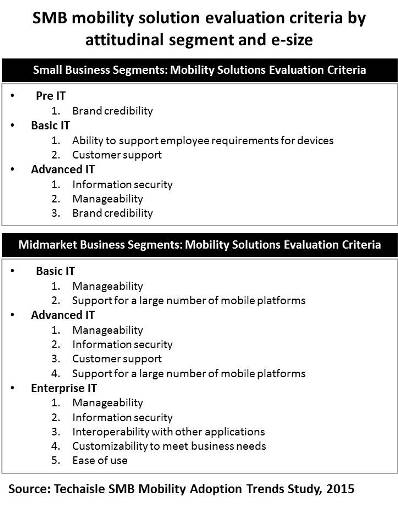
Figure below presents an analysis of SMB mobility solution evaluation criteria, tied to the attitudinal groups used for SMB segmentation analysis. This segmentation and perspective highlights how increased sophistication changes the requirements that SMB users have of suppliers.

techaisle-smb-mobility-solution-evaluation-criteria-image 

Small Business Segments
Within the small businesses, the Pre-IT segment is looking first and foremost for a trusted brand. These small business buyers opt for horizontal suppliers for their first step into mobility solutions. Data from other segments suggests that increasing sophistication leads to more exacting expectations.

Basic IT buyers are looking for help with managing BYOD and for effective customer support, while Advanced IT buyers look for assurances of information security, for manageability, and for suppliers’ credible brands.

Midmarket segments
“Manageability” is the most essential attribute for suppliers targeting midmarket firms. The basic IT segment is looking for assistance in supporting a large number of mobile platforms as a means of dealing with the BYOD needs of a larger (relative to small business) workforce, and/or as a means of supporting customer access to public systems.

The midmarket Advanced IT group, like its small business peers, requires a combination of manageability and information security, and adds customer support and the requirement for multi-device/platform support.

The enterprise IT group –the largest spenders represented in this chart – have a few unique requirements. This group demands interoperability and customizability as it seeks to integrate mobility solutions within the broader IT infrastructure, and looks as well for ease of use as it rolls out mobility solutions to a (relatively) large and diverse workforce. Techaisle expects that over time, an increasing number of SMBs will pursue these capabilities as they, too, tie mobility into their overall IT/business architectures.


Dr. Cooram Ramacharlu Sridhar

What is the big deal with ANN?

In the thirty years from the time Shunu Sen posed the marketing-mix problems, I have been busy with marketing research. I tried modeling most of the studies and discovered that market research data alone is not amenable to statistical predictive modeling. Take for example, imagery. Is there a correlation between Image parameters and Purchase Intention scores? There should be. But rarely does one get more than a 0.35 correlation coefficient. Try and link awareness, imagery, intention to buy, product knowledge, brand equity, etc. to the performance of the brand in the market place and one discovers land mines, unanswered questions and inactionability.

This is where ANN steps in.

Technically ANN (Artificial Neural Networks) offers a number of advantages that statistical models do not. I will list a few of them.

    1. Non-linear models are a tremendous advantage to a modeler. The real world is non-linear and any linear model is a huge approximation.


    1. In a statistical model, the model gives the error and one can do precious little to decrease the error. In ANN one can specify the error tolerance. For example we can fit a model for 85, 90, 95 or 99% error. It requires some expertise to figure out whether there is an over fit and what is the optimum error one can accept.


    1. Statistical models make assumptions on distributions that are not real in the real world. ANNs make no distribution assumptions.


    1. Most ANN software available today do not identify the functions that are fitted. We, on the other hand, have been able to identify the functions that are fitted and how to extract the weights and build them into an algorithm.


How do we bring the differentiation?

Our biggest strength is in data integration that combines market research and economic data with transaction data into a single file. This is tricky and requires some ingenuity. We use Monte Carlo techniques to build these files and then use ANN for building the Simulation models. Optimization then becomes clear and straight forward since we do not use statistical models. Optimization using statistical modeling, which most modelers use, is a nightmare. Most of the large IT vendors and even analytics companies continue to use statistical modeling for Optimization. And therein lays the problem. Neither are these companies aware of the possibilities that ANN can provide. Most modeling is done using aggregate data, whereas we handle the data at the respondent level. The conventional modeling is macro data oriented whereas we are micro data oriented. Hence the possibilities that we can generate with micro data for modeling is huge, compared to macro data.

We have crossed the stage of theories. There are many projects that we have executed successfully that have gone on to become a must-have analytical marketing input mechanism.

Doc
Techaisle

Anurag Agrawal

Mobility is Strategic for 13 percent of SMBs - Meet "Aggressive Adopters" Segment

techaisle-smb-infographic-mobility-segmentationTechaisle’s SMB Mobility adoption research and corresponding segmentation shows that there are three distinct SMB segments of mobility solution users.

Aggressive Adopters: Mobility is Strategic to their business; these form 13 percent of SMBs

Steady Movers: Mobility is enabled in their business; by far the largest segment at 49 percent of SMBs

Fence Sitters: Mobility is a convenience for their business; these form 19 percent of SMBs

It is imperative for IT Vendors and channels to understand the segments' different attitudes towards mobility, current and planned usage of mobility and firmographics to create an actionable marketing strategey. For example, Techaisle’s SMB Mobility Segmentation shows that for 13 percent of SMBs that fall into the Aggressive Adopters segment mobility is strategic to their business growth and survival. A deep understanding of the three segments will help IT vendors and channel partners identify their target markets and how to sell into them.

Sales Strategies for SMB Mobility Segments

techaisle-smb-mobility-segments-1

Even in terms of spending, aggressive adopters are spending a higher percentage of their IT budget on mobility solutions. Interestingly, Fence Sitters are spending comparatively higher percentage on mobility consulting assessments looking for advice on the most appropriate solutions before adopting mobility enterprise-wide.

BYOD Policy and Use of Tablets & Smartphones

Not only Aggressive Adopters were the first to use tablets and smartphones but they also have the highest density (mobile devices per employees) and highest average number of tablets and smartphones being used at all employee size levels among all three segments.

techaisle-smb-mobility-segments-2

There are twice as many SMBs in the Aggressive Adopters segment as Fence Sitters that use Tablets and Smartphones.

Aggressive Adopters have also moved quickly to implement a BYOD policy whereas a large percentage of Steady Movers do not have a BYOD policy but they also do not stop their employees from using their own devices.


techaisle-smb-mobility-segments-3

Aggressive Adopters also have a very healthy attitude towards employees using consumer applications at work as they feel it is a good way to learn about technology that their employees find useful and can be officially integrated into their business.


techaisle-smb-mobility-segments-4


Adoption of mobility solutions has also led to a positive effect on work-life balance of their employees. Aggressive Adopters have also seen improved productivity, higher employee satisfaction and improved quality of work.


With improved productivity and quality of work there will be a continued proliferation of mobile devices and corresponding solutions that will drive new forms of collaboration of content and communication. As devices become increasingly small, smart, connected and powerful, the server and network become less visible progressively moving offsite both physically and from a management perspective, simultaneously serving more computing power, storage and bandwidth; mobility will revolve around collaboration delivered through an enhanced browser. Therefore, todays Aggressive Adopters will look for integration of communication channels, content and workflow as the foundation on which to build their strategic mobile solutions.


The responsibility lies with the IT Vendors and their channel partners to effectively mine the Aggressive Adopters’ segment at the same time using realized proof points to move each of the other two segments (Steady Movers and Fence Sitters) to the Aggressive Adopter segment.

In terms of market opportunity, Aggressive Adopters show the highest growth rate for mobility spending requiring sophisticated solutions whereas Steady Movers have the biggest size due to sheer volume of SMBs falling into the category.

Trusted Research | Strategic Insight

Techaisle - TA