










• TRUSTED RESEARCH

    TRUSTED RESEARCH | STRATEGIC INSIGHT

    SMB. CORE MIDMARKET. UPPER MIDMARKET. ECOSYSTEM
    LEARN MORE
  • INTERWORK 2.0: THE AGENTIC FUTURE OF CONNECTED BUSINESS

    INTERWORK 2.0: THE AGENTIC FUTURE OF CONNECTED BUSINESS

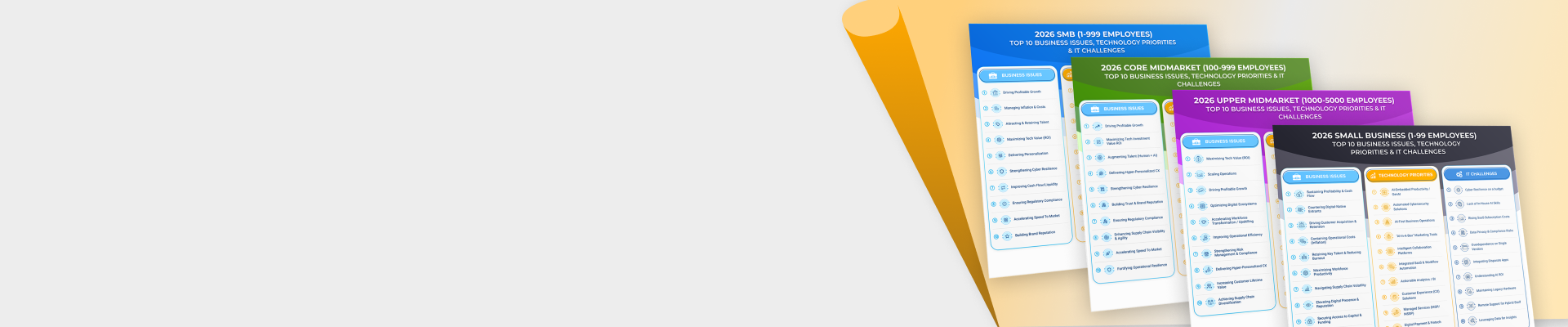
  • 2026 TOP 10 SMB BUSINESS ISSUES, IT PRIORITIES, IT CHALLENGES

    2026 TOP 10 SMB BUSINESS ISSUES, IT PRIORITIES, IT CHALLENGES

  • 2026 TOP 10 SMB PREDICTIONS

    2026 TOP 10 SMB PREDICTIONS

    SMB & Midmarket: Autonomous Business
    READ
  • 2026 TOP 10 PARTNER PREDICTIONS

    2026 TOP 10 PARTNER PREDICTIONS

    Partner & Ecosystem: Next Horizon
    READ
  • ARTIFICIAL INTELLIGENCE

    ARTIFICIAL INTELLIGENCE

    SMB & Midmarket Analytics & Artificial Intelligence Adoption
    LEARN MORE
  • IT SECURITY TRENDS

    IT SECURITY TRENDS

    SMB & Midmarket Security Adoption Trends
    LATEST RESEARCH
  • BUYERS JOURNEY

    BUYERS JOURNEY

    Technology Buyer Persona Research
    LEARN MORE
  • PARTNER ECOSYSTEM

    PARTNER ECOSYSTEM

    Global Channel Partner Trends
    LATEST RESEARCH
  • CLOUD ADOPTION TRENDS

    CLOUD ADOPTION TRENDS

    SMB & Midmarket Cloud Adoption
    LATEST RESEARCH
  • FUTURE OF PARTNER ECOSYSTEM

    FUTURE OF PARTNER ECOSYSTEM

    Networked, Engaged, Extended, Hybrid
    DOWNLOAD NOW
  • MANAGED SERVICES RESEARCH

    MANAGED SERVICES RESEARCH

    SMB & Midmarket Managed Services Adoption
    LEARN MORE

Techaisle Analyst Insights

Trusted research and strategic insight decoding SMBs, the Midmarket, and the Partner Ecosystem.
Anurag Agrawal

15 Keys: Winning Strategies of Successful SMB Cloud Channel Partners

Techaisle’s extensive primary research based study finds that there are quantitative, meaningful and actionable differences between channel partners who are successful in the business of selling Cloud and those that have not developed successful SMB Cloud practices.

The study to understand the winning strategies for selling Cloud to SMBs and to enable channel partners and their vendor suppliers build viable, high-growth SMB cloud businesses uncovered 15 best practices and critical differences between the activities and approaches of successful and unsuccessful SMB Cloud computing channel partners. These 15 keys are grouped into three areas.

Corporate priorities and allocations:

1.   There is no organizational recipe for cloud success
2.   Familiarity breeds success
3.   The “why” behind the cloud initiative often helps explain success
4.   Recurring revenue is not the sole indicator of cloud business success

Technology and offering definition:

5.   Cloud rewards suppliers that focus on providing best-of-breed
6.   Branded solutions are a key element of channel cloud success
7.   Industry expertise is a more important differentiator than technical prowess
8.   Cloud portfolios need to extend beyond basic IaaS, SaaS to also encompass verticals
9.   Data integration linking on-premise and cloud environments is non-optional
10. The future is hybrid, not private

Sales and marketing strategies and tactic:

11. The nature of sales relationship is a critical determinant of cloud success
12. Profit is driven by product/service balance
13. Partner-to-partner relationships are important to cloud business success
14. A distinctive approach to budget and resource allocation creates differentiation
15. Creating a cost-effective, scalable approach to lead generation is imperative

Detailed analysis included in the report highlights key differences between:

  • Channel partners that are very successful and are making money selling cloud to SMBs

  • Channel partners that have just achieved success and have started making money selling cloud to SMBs

  • Channel partners that are not yet successful and are not making money from their SMB cloud business


Working with SMBs, the channel and the vendor community, Techaisle has created research materials that help reduce time-to-success and increase the overall benefit of offering SMB solutions. Channel members looking to build a successful cloud business practice, or a vendor looking to accelerate channel success, can find details of the report here, or send us an email at This email address is being protected from spambots. You need JavaScript enabled to view it.

 
Anurag Agrawal

Big Data technology of interest to mid-market businesses

Techaisle’s global mid-market businesses’ Big Data Adoption & Trends study shows that the promise of superior data-driven decision making is motivating 43 percent of global mid-market businesses to either invest in or investigate Big Data technology. Out of these, 18 percent of mid-market businesses are actively investing in big data related projects. The possibilities of analyzing a variety of data sources, producing action-driven business insights is too big to ignore for mid-market businesses.

Big Data requires a certain level of IT sophistication and a history in the linear investment in Information Technology enablers to be successfully. While these factors predispose larger accounts to Big Data, the competitive imperative to understand customers, innovate products and improve operational efficiencies has already started to reach down to the mid-Market, forcing a search for how to leverage primary and secondary data that is generated by the business.

The current and planned investment represents a sizable opportunity considering that the segment is relatively new and requires a certain level of IT sophistication and a history in linear investment in Information Technology enablers to be successful. North America has both the largest market and the highest level of investment in Big Data overall in SMB and mid-market segments. Mid-Market attitude towards Big Data transitions from “Over-Hype” to “Must-Have” technology with the increase in employee size. However, nearly one-fourth of lower mid-market businesses consider big data to be over-hyped and yet 29 percent think that it will be an important part of their business decision making process in the future.

Business intelligence by itself has provided enough business insights, however, mid-market businesses are now looking for extracting business perspectives to drive superior decisions and ultimately achieve superior results.  Extracting business perspectives has become important as they rethink their marketing strategies because mobility, social media, and other transactional services have increased the number avenues for connections with their customers and partners.

In addition to understanding customers, mid-market businesses are also considering big data analytics as an important initiative to help them improve operational efficiencies.

Techaisle’s study shows that there are many different tactical objectives for deploying big data projects but the top among them are sentiment monitoring, generating new revenue streams & improving predictive analytics. It must also be said that businesses have figured out that there is a lot of publicly available data which could also be analyzed to their advantage.

The mid-market businesses actively investing in big data technologies are expecting some clear cut benefits from big data analytics such as increased sales, more efficient operations and improved customer service. These objectives differ slightly by different geographic regions. As the growth rates continue to lag in mature economies, the pressure to increase revenue grows resulting in developing robust analysis and extracting insights from all sales and customer data including transactions.

When specifically asked about preferred deployment choice in terms of on-premise vs. cloud, mid-market businesses are unsure as they are still navigating through their technology options. However, Hadoop dominates as the preferred platform but confusion exists.

In terms of analytics skill-set and long-term vision, the potential of linking structured and unstructured data sources to create new business insights is being considered very useful but at the same time mid-market businesses are not really prepared for it. In fact one-third of mid-market businesses agree that linking structured and unstructured data would be very useful for big data analytics but over 70 percent mention that they have either none or very limited capabilities of analyzing unstructured data. This is where they are turning to external help for guidance.

Needless to say, survey reveals that big data deployment is posing tremendous challenges. Technology confusion, lack of skilled resources and potential unclean data are being considered as the biggest roadblocks for big data project implementations. Big data technology and its far-reaching capabilities are being viewed by mid-market businesses as very complex resulting in very steep learning curves.

In spite of challenges, the study shows that there have been some successes when business units, IT & data analysts exhibit extraordinary alignment. Highest success rates for project implementation and generating new insights have been achieved when IT and data analysts work with external consultants from project inceptions.

Detailed Global Mid-Market Big Data Adoption and Trends report is available for purchase. Details are given here.
Anurag Agrawal

Are SMBs the guiding path to Big Data Simplicity?

Various organizations define Big Data differently. Some use “petabytes of data” as a benchmark to isolate big data from other normalized and structured data sets that exist within an organization. However, this measure quickly boxes big data analytics into the large enterprise market segment. Small and mid-market businesses certainly do not have this extent of data but Big Data still relevant for them. In fact Big Data solutions are more relevant for Small and Mid-Market businesses. However, it will take some creativity on the part of solution providers to make Big Data accessible, easy to use and comprehend for segment that constitutes 97 percent of global businesses.

Cloud computing started as an enterprise play, however, it was quickly discovered that SMBs will be the more relevant target segment with a faster path to adoption. Similarly, as Virtualization market started getting fully penetrated within the enterprises, vendors shifted their focus to the SMBs with some very creative solutions. As far as big data is concerned SMBs are starting to show interest and even adoption. However, there is a stark difference in approaches between mid-market businesses and small businesses. While mid-market businesses are experimenting with bespoke solutions, small businesses are gravitating towards a multi-tenant, aggregated and federated big data solution that has a mix of publicly available data and their own internal data.

It is expected that in year 2016, global SMBs would spend US$1.6 Billion on big data solutions exhibiting a growth rate that is faster than what was exhibited by cloud computing solutions. Cumulatively between now and end of 2016, SMBs itself would have shelled out US$3.9 billion on big data solutions. This spending includes hardware, software and services.

So why are many big data solution providers ignoring SMBs? Simply put, because of perceived complexity and inability to create bite-sized messaging that directly address SMBs pain-points. But they should not forget that business intelligence has now become one of the fastest solutions to be adopted by SMBs. If done right, Big data address three key pain points of SMBs: Increase sales, Efficient operations, Improve Customer service.

Promise of Superior Decision Making

Let us take Techaisle’s recent global mid-market businesses’ Big Data Adoption & Trends study which clearly shows that the promise of superior data-driven decision making is motivating 43 percent of global mid-market businesses to either invest in or investigate Big Data technology. Out of these, 18 percent of mid-market businesses are actively investing in big data related projects. The possibilities of analyzing a variety of data sources, producing action-driven business insights is too big to ignore for these businesses.

Similar to cloud, the attitude towards Big Data is transitioning from “Over-Hype” to “Must-Have” technology with the size of business. Even within the businesses that consider big data to be over-hyped, 29 percent think that it will be an important part of their business decision making process in the future.

Extracting Business Perspectives

Business intelligence by itself has provided enough business insights, however, mid-market businesses are now looking for extracting business perspectives to drive superior decisions and ultimately achieve superior results.  Extracting business perspectives has become important as they rethink their marketing strategies because mobility, social media, and other transactional services have increased the number avenues for connections with their customers and partners.

CRM solutions had first established the analytics for analyzing customer data. However, the data was mostly two-way transactional data. This changed when customers began visiting business websites to explore, browse and perhaps make purchases thus leaving behind a trail of information. IT vendors and mid-market businesses figured out the need to analyze the data and combine it with transactional information.

However, everything changed with the onset of social media, blogs, forums, wikis and opinion platforms where the identification of false positives and negatives became difficult and knowledge about the customer and resulting segmentation became an inaccurate undertaking.

Big data analytics presents the possibilities of connecting together a variety of data sets from disconnected sources to produce business insights whether be for generating sales, improving products or detecting fraud.

It is therefore not surprising that global mid-market businesses are turning towards big data analytics to analyze social media data, web data, customer and sales data along with click-stream machine generated data and even communications data in the form of emails, chat, voicemails.

Leap of Faith or Solution Readiness

Analyzing data from diverse sources leads a mid-market business to naturally consider linking structured and unstructured data. This also drives them to evaluate and select the technology that can be used for simplified implementation. Simplified implementation is important because mid-market businesses do not yet have in-house capabilities to analyze unstructured data and those that have them consider the capabilities at best rudimentary.

Big data therefore is a major leap of faith for mid-market businesses resulting in treating big data analytics projects usually as separate to the existing analytics within the business. More aggressive adopters are planning to use big data analytics along with other analytics in a coordinated manner so that one does not become an inhibitor for the other.

In recent years technology and technology options have evolved extremely rapidly for an average business to understand, evaluate, purchase and implement. The complexity gets further exacerbated with lack of experience, lack of skilled manpower and innate difficulty in identifying external consultants that would be the most right fit for their business objectives and budget availability.

In spite of challenges, the study shows that there have been some successes when business units, IT & data analysts exhibit extraordinary alignment. Our study shows that mid-market businesses typically started their big data journey in one of four ways. Highest success rates for project implementation and generating new insights have been achieved when IT and data analysts work with external consultants from project inceptions.

SMBs as the Path to Big Data Simplicity

The global SMB spend on big-data related deployments will cross US$1.0 billion in 2013 which is a 32 percent increase from 2012. SMBs are still experimenting to see if big data analytics can provide newer insights into their operations and better knowledge about their customers. It is still very early days for small and mid-market businesses to fully embrace big data but they are planting the seeds in terms of re-architecting their IT infrastructure to plan for the future. But we believe that SMBs may very well race ahead of enterprises with their deployments as technology becomes simpler and consultants become experienced.

 
Anurag Agrawal

SMBs Mixing and Matching Vendors to Find Best Virtualization Solutions

Techaisle’s SMB technology adoption study shows that 72 percent of SMBs find Virtualization to be one of the most relevant technologies for their business, 2nd only to backup and disaster recovery. The actual adoption gets hindered because 56 percent of SMBs find Virtualization to also be one the most complex technologies to understand and adopt. (See infographic)

SMBs cite several reasons for adopting server virtualization; key among them are reducing operating cost, backup and disaster recovery and reducing cost of IT support. Improving existing server and hardware systems utilization is mentioned by 32 percent of SMBs.

In our survey of SMBs either currently using or planning to use Virtualization technologies we found that SMBs currently using Virtualization tended to have a mixed brand Virtualization environment, not relying on a single vendor for the solution, but mixing and matching as they saw appropriate based on their specific requirements.

techaisle-smb-diverse-virtualization-installations


For example, the above chart shows that within VMware Server Virtualization environments, 66 percent of SMBs also use VMware client Virtualization technology, with both Microsoft and Citrix making up the difference for the client side. Similarly, 78 percent of SMBs that use Microsoft server Virtualization also use Microsoft client Virtualization. Several other findings become apparent from the above chart:

  • VMware and Citrix have the most relatively mixed virtualization environment as compared to Microsoft

  • Citrix and Microsoft may have a slightly deeper partnership that enables SMBs using Citrix server Virtualization to be combined with Microsoft client Virtualization more easily and cost effectively


However, we cannot look at the above chart in isolation. SMBs have been using Virtualization technologies as the market developed.

In the words of one VP of IT for a mid-market business, “We use Citrix, VMware, Microsoft Hyper-V, and emulation from Ericom. There are ‘n’ numbers of products that are being used in the whole gamut of things”.

The Venn diagram below not only exposes the vulnerabilities faced by Virtualization vendors but also demonstrates that the market is big enough for solutions from all vendors to work in a heterogeneous IT environment.

techaisle-smb-virtualization-mixed-brand-adoption


For example, the above Venn diagram shows that only 12 percent of SMBs use only VMware Virtualization solution which is twice that of Citrix and almost one-fourth of Microsoft. And 9 percent of SMBs use Virtualization solutions from VMware, Citrix and Microsoft. Once we start to include solutions from Parallels, NComputing, Oracle and others the overlaps become very complicated to map.


Our research found that SMBs usually go through a round of server consolidation before moving to Virtualization.

“The very first step was actually to go for server consolidation. Once the servers were consolidated, then the desktop virtualization was performed. So, typically for VDI architecture or any other technology, the first thing is the server consolidation and after that the procurement of solution and licenses were done from VMware and Citrix for the VDI and after which the user terminals were changed”, this according to one IT Director, Mid-market business.

Not all Virtualization projects finish smoothly. SMBs have also had different experiences with each of the three major brands for server Virtualization projects as shown in the chart below:

techaisle-smb-virtualization-project-implementation-issues


The factors affecting each of the projects could be dependent upon:

  • SMBs’ readiness

  • Channel partners’ capabilities


However, the top 3 most common areas that need addressing are Compatibility Issues, Cost Overruns and Lack of Experience, which are perennial issues as all SMB users adopt new technologies.

“The major challenge was the cost, because the initial hardware investment was huge. Getting rid of the system and moving to the cloud and installing virtual servers required purchasing of physical storage and upgrading the system. Another challenge that we faced was the initial configuration which was addressed timely and efficiently by our partners”, Vice President, IT (500 employee size company).

But SMBs have gained tremendous advantages from using Virtualization. “It certainly has helped us to avail richer network services without increasing our capital investment and has increased our operational efficiency. Moreover computing and networking are much simplified now”.

For additional information on this and other topics from the blog, please feel free to contact us for a discussion and gratis consultation.

To purchase Techaisle’s SMB Virtualization Trends and Adoption study or engage Techaisle in a deep-dive custom research please send an email to This email address is being protected from spambots. You need JavaScript enabled to view it.


Trusted Research | Strategic Insight

Techaisle - TA