










Techaisle Analyst Insights
2026 Top 15 Channel Partner Business Challenges and Priorities
The channel is no longer just at a pivot point; it has moved past the intersection entirely. For the last decade, we have analyzed the "MSP pivot" and the "cloud transition." Those chapters are closed. As we look toward 2026, the channel is entering the Agentic Era—a period defined not by the technology partners sell, but by the autonomous outcomes they package.
Typically, Techaisle distills the annual landscape into a "Top 10" list. But 2026 is an exception. In our latest study of 4,500 channel partners globally, the data revealed a level of interconnectivity and operational friction so dense that a list of ten simply couldn't capture the strategic reality. We expanded our analysis to the Top 15 Business Challenges and Priorities because the pressures facing partners today aren't isolated silos—they are a complex web of margin compression, AI ambiguity, and ecosystem sprawl.
The data reveals a stark reality: the traditional "labor-plus-license" model is facing an existential squeeze as the channel navigates a shift from service delivery to agentic orchestration. Here is my analysis of the 15 critical forces shaping the channel in 2026.
The 2026 Business Challenges: The Profitability and Operational Squeeze
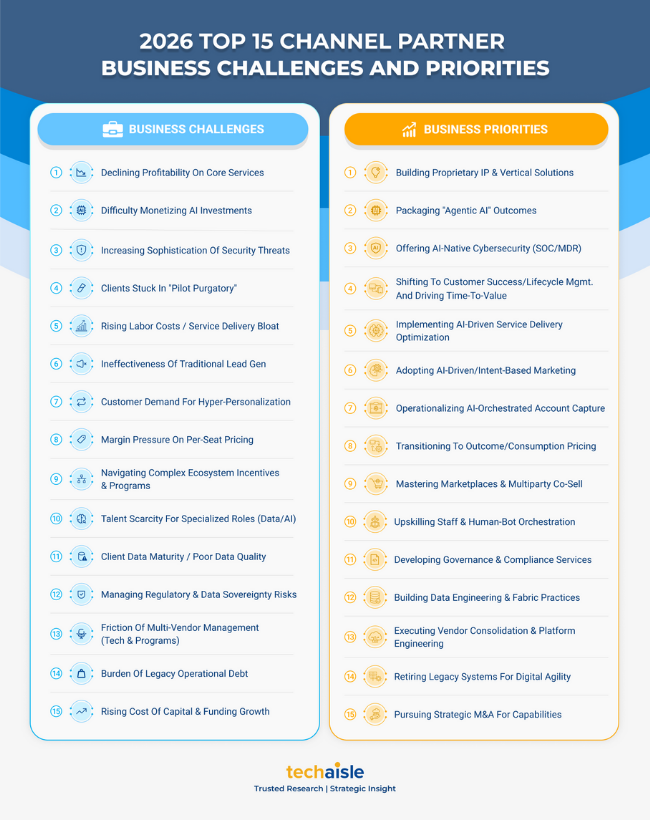
We see a partner ecosystem that is simultaneously optimistic about AI and suffocated by its current business model. The single most pressing issue, ranking at #1, is "Declining profitability on core services." This is the defining signal of the year. For two decades, partners relied on the high gross margins of managed services to subsidize the lower margins of hardware and software resale. But as hyperscalers compress infrastructure margins and automation commoditizes Level 1 and Level 2 support, that safety net is disintegrating.
This profitability crisis is compounded by the "Difficulty monetizing AI investments" (Rank #2). Over the last 18 months, partners have aggressively marketed AI, but the data shows that clients are stuck in "Pilot Purgatory" (Rank #4). Partners have successfully sold the promise of AI, but they are struggling to translate technology demonstrations into recurring, high-margin revenue streams. The industry is caught in the middle: carrying the cost of AI innovation without yet realizing the financial return.
At the same time, the operational environment has become hostile to the traditional "middleman" role. "Navigating complex ecosystem incentives & programs" has risen to a top-tier challenge (Rank #9), joined by the "Friction of multi-vendor management" (Rank #13). In the past, partners managed a handful of primary vendors. Today, they navigate a labyrinth of hyperscaler marketplaces, distributor platforms, and dozens of ISV point solutions. The administrative burden of tracking backend rebates, certifications, and tier requirements is crushing operational agility. When combined with "Rising labor costs" (Rank #5) and "Talent scarcity" (Rank #10), the message is clear: the current operational structure of the channel is too expensive to maintain.
The Business Priorities: The Pivot to IP and Agentic Orchestration
If the challenges define the pressure, the priorities define the escape route. The response from the 4,500 partners in our study is a decisive shift toward Intellectual Property (IP) and Agentic Orchestration.
The #1 priority for 2026 is "Building proprietary IP & vertical solutions." This is no longer an optional "value-add"—it is a survival mechanism. In a market where resale margins are vanishing, partners are realizing that if they are not wrapping their own IP around a vendor’s solution, they are merely transacting agents. This aligns directly with the shift to "Outcome/consumption pricing" (Rank #8). Partners are moving away from the "per-seat" model—which punishes efficiency—to billing for the business result, such as a secured endpoint or an automated workflow.
The solution to the "AI monetization gap" is identified as "Packaging 'Agentic AI' outcomes" (Rank #2). This represents a maturity leap from selling tools (Copilots) to selling autonomous workers (Agents). Partners are prioritizing the engineering of "Time-to-Value," recognizing that in the Agentic Era, value must be realized in days, not quarters.
To support this new model, partners are executing a massive operational reset. The priority of "Human-Bot Orchestration" (Rank #10) and "Implementing AI-Driven Service Delivery Optimization" (Rank #5) signals that partners are using AI to heal their own margin wounds. By deploying internal AI to handle up to 40% of service tickets, they free up expensive human talent for the high-value work of "Building Data Engineering & Fabric practices" (Rank #11) and "Governance & Compliance services" (Rank #12). Partners have accepted that they cannot build Agentic AI on a foundation of poor data, making data governance the new "infrastructure" project that feeds the managed service tail.
The Bottom Line for 2026
The Techaisle study of 4,500 partners makes one thing abundantly clear: 2026 is not a year for incremental improvement. It is a year of structural integration.
- Integration of IP into services to protect margins.
- Integration of AI into labor to lower costs.
- Integration of Governance into data to enable automation.
- Integration of Platforms to simplify ecosystem complexity.
The partners who will thrive are not necessarily the ones with the best engineers, but the ones with the best business architects—those who can assemble these disparate pieces into a coherent, profitable, and automated whole. The challenges are steep, but the clarity of these priorities suggests that the channel is ready to evolve.
When you subscribe to the blog, we will send you an e-mail when there are new updates on the site so you wouldn't miss them.