











Techaisle Analyst Insights
The Industrial Revolution of AI: Why Lenovo’s Strategic Stake in Inferencing Matters More Than the Specs
The gold rush for training Large Language Models (LLMs) has dominated headlines for the past two years. However, for the vast majority of businesses that are not OpenAI, Anthropic, or Google, the training war is effectively over. They never needed to fight it in the first place.
As the industry moves into 2026, the market is shifting decisively from the experimental phase of AI training to the industrial execution of AI inferencing. This is where the capital will be deployed, and more importantly, where the tangible value will be extracted.
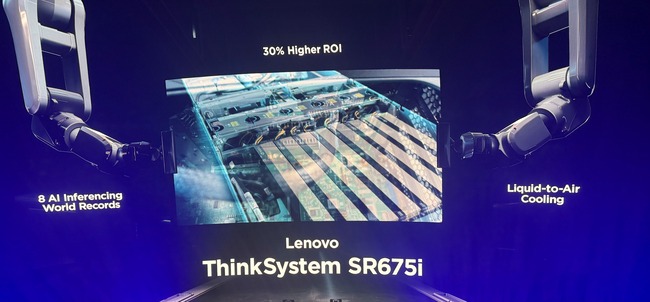
At CES 2026, Lenovo officially announced its strategy to claim leadership in this inferencing landscape. I recently attended an exclusive analyst briefing ahead of this launch where the company detailed a robust portfolio expansion anchored by three new servers—the Lenovo ThinkEdge SE455i, Lenovo ThinkSystem SR650i, and SR675i—and a comprehensive ecosystem of strategic partners. But looking past the technical specifications, which are becoming table stakes, Lenovo is attempting something more ambitious. It is positioning itself not merely as a hardware supplier for the AI era, but as the architect of a Hybrid AI factory.
Here is my analysis of why this strategy matters, where the differentiation is real versus marketing aspiration, and what this means for the broader ecosystem.
The Core Thesis: Cloud Smart, Not Cloud First
The most compelling argument Lenovo is making is economic rather than purely technical. For the past decade, the prevailing industry narrative has been "Cloud First." In the AI era, that narrative is colliding with the complex realities of physics and finance.
We are witnessing a significant "cloud hangover" among CIOs. The cost per token of running persistent, high-volume inference in the public cloud is becoming mathematically unsustainable for many enterprises. Techaisle analysis suggests that while the cloud remains superior for "bursty" training workloads, it imposes a severe premium on "steady-state" inference. If a retailer runs real-time loss prevention across 2,000 stores, or a bank processes millions of transactions per second to detect fraud, relying solely on cloud GPU instances is a fast track to eroding margins.
We believe the market has hit a "Breakeven Wall." For constant, 24/7 inference workloads, the crossover point where on-premises infrastructure becomes cheaper than public cloud rental is now measured in months, not years. This is the "hidden tax" of the AI era: renting a GPU for a science project is OpEx-smart; renting it for a core business process is CapEx-foolish.
Lenovo’s differentiation relies on a simple premise: Bring the AI to the data, not the data to the AI.
This is Hybrid AI in practice. The differentiation here lies in data gravity. Moving petabytes of data to the cloud for inference introduces latency, security risks, and exorbitant ingress and egress fees. Critically, Lenovo is dismantling the perception that on-premises AI requires exotic, cost-prohibitive appliances. It is positioning its new inferencing portfolio not as specialized gear reserved for the high end, but as general-purpose, mainstream infrastructure. These are systems that data center and IT managers are already accustomed to deploying, racking, and managing within their existing operational models. By offering this familiar, mainstream hardware, Lenovo is effectively selling insurance against the volatility of cloud pricing. It provides predictable costs for workloads that are constant and predictable.
The Hardware Reality: Reliability as Business Continuity
However, predictable costs mean nothing without predictable performance. As enterprises repatriate workloads from the cloud, they also repatriate the risk of infrastructure failure. This raises a critical question: In a market currently driven by the "fear of missing out" (FOMO) and rapid experimentation, does a GenAI buyer actually prioritize supply chain reliability?
The answer is yes—but only if framed correctly. In the AI era, reliability is not about server uptime statistics; it is about business continuity. If an organization runs an AI agent that handles 50% of its customer service interactions, or a manufacturing defect-detection system on a live assembly line, downtime is not an IT ticket; it is an immediate loss of revenue.
Lenovo’s new hardware trio targets three specific reliability zones:
- The Edge (Lenovo ThinkEdge SE455i): This addresses the frontier of inference—retail stores, telco towers, and factory floors. The differentiation here is density and physical resilience. You cannot place a delicate data center server in a dusty warehouse. This unit is optimized for real-time inference at the source, offering ultra-low latency, which is crucial for immediate decision-making.
- The Workhorse (Lenovo ThinkSystem SR650i): This targets the middle ground—general-purpose inference where cost and scalability matter more than raw power. It is designed for efficient data center inferencing, balancing performance with proven reliability for standard enterprise workloads.
- The Beast (Lenovo ThinkSystem SR675i): This is where Lenovo flexes its engineering capabilities. The ability to pack a full, multi-billion-parameter model into a single server using advanced GPU density is a legitimate engineering feat. It serves as a single platform capable of handling both heavy inferencing and model fine-tuning, maximizing tokens per watt.
The critical advantage for Lenovo hardware is not the silicon, which it sources from NVIDIA or AMD, as its competitors do, but its Neptune liquid-cooling technology. As racks approach megawatt density, traditional air cooling is becoming obsolete. Lenovo’s ability to offer liquid cooling that mitigates leak risks—a significant issue cited with competitors like Dell and Supermicro—is a practical differentiator for data centers running intensive AI workloads.
The Services Advantage: Orchestrating Industrial-Grade Inference
Hardware provides the compute, but in the world of inferencing, the complexity lies in the deployment. An enterprise does not simply "turn on" AI; it must select the right model, optimize it for the specific hardware (quantization), and integrate it into existing workflows. Lenovo recognizes that the gap between a trained model and a running inference engine is where most projects fail. It is leveraging its "One Lenovo" strategy to bridge this gap.
By mobilizing its ecosystem of ISVs, partners, and its own Services Group (SSG), Lenovo is creating unified Inferencing solution offerings. This approach transforms the complex landscape of model selection and hardware sizing into a model of Curated Excellence. Rather than overwhelming partners with the Paradox of Choice—asking them to choose between Llama 3, Mistral, or a proprietary model, and then pairing it with the correct NPU or GPU configuration—Lenovo is using its advisory services to architect the solution, or to offer vertical or horizontal AI ISV solutions.
Lenovo’s AI Advisory Services is the linchpin in "industrializing" inference. It delivers a seamless integration between the server infrastructure and the specific inference workload. By acting as the general contractor, Lenovo helps customers determine exactly where that inference should live—whether it is a high-frequency trading algorithm running on the SR675i or a visual inspection model running on the SE455i at the edge.
By assuming the integration burden of the "Hybrid AI factory," Lenovo empowers its partners to sell inference outcomes—such as "frictionless checkout" or "predictive maintenance"—rather than just capacity. This shift from aggregation to curation positions Lenovo not just as a vendor of compute, but as the trusted partner capable of operationalizing AI inference at scale.
Market Impact Analysis: The Inference Economy
1. For SMBs: The "Inference-in-a-Box" Necessity
Small businesses will likely never train a model; their relationship with AI is through consumption. Techaisle research reveals that 94% of SMBs are currently using or planning to use GenAI, yet they are often paralyzed by the complexity of deployment. They need a toaster—plug it in, and it makes toast. With 42% of SMBs already gravitating toward hybrid AI solutions, Lenovo’s push for pre-integrated inference appliances is vital. SMBs will not buy a server; they will buy a "Retail Loss Prevention Appliance" powered by inference. Lenovo’s ability to hide the complexity of the inference stack is its winning hand in this segment.
2. For Midmarket Firms: Repatriating the Token Spend
This is the primary battleground for cost. Midmarket firms migrated to the cloud for agility but are now confronting the mathematical reality of recurring inference costs. Techaisle data indicates that 64% of midmarket firms are prioritizing Hybrid AI strategies to balance performance with cost control. These firms have steady-state workloads that justify on-premises hardware. Lenovo’s message is financially compelling here: Rent the training (cloud), but own the inference (on-prem) to capitalize on lower per-token costs.
3. For Enterprise Customers: The Private RAG Architecture
For the Global 2000, particularly in regulated industries like Finance and Healthcare, the driver is not just cost, but the privacy of the inference context. With inference workloads projected to account for 55% of all AI-optimized infrastructure spending by 2026, enterprises are hesitant to send real-time, sensitive customer data to a public cloud. Lenovo’s ability to offer Private AI infrastructure—where the inference engine sits directly next to the secure data storage—is the definitive architecture for secure RAG. The challenge remains orchestrating this data; Lenovo must prove its infrastructure can handle the high-throughput, low-latency demands of private inference without creating data silos.
4. For Channel Partners: Selling the Inference Outcome
The era of selling "capacity" is over. Margins on hardware are negligible. The value lies in applying inference. My advice to Lenovo’s channel partners is simple: Verticalize or Evaporate. You cannot be a generalist AI partner. You must be the expert in "Inference for Regional Banking Fraud Detection" or "Inference for Automotive Quality Control." Lenovo provides a curated library of inference agents; partners must provide the vertical context to deploy them.
Conclusion: Defining the Taxonomy of Inference
Lenovo is claiming territory in a market that remains wide open. While the industry spent the last two years obsessing over who could build the biggest brain (training), Lenovo is betting on who can put that brain to work (inferencing).
This strategy is physically codified in the three platforms announced. The Lenovo ThinkEdge SE455i anchors the reality of inference at the edge, where data is born; the Lenovo ThinkSystem SR650i provides the sheer scale required for the enterprise core; and the Lenovo ThinkSystem SR675i bridges the gap between heavy inference and fine-tuning. This "flag plant" is timely. The race is no longer about parameters; it is about production.
While Dell and HPE are fighting similar battles, Lenovo’s focus on the specific engineering challenges of inference—handling heat through Neptune liquid cooling and managing density at the edge—gives it a tactical advantage. However, the hardware is merely the delivery mechanism. The market will be won based on usability. Can Lenovo take a complex stack of silicon, cooling, and model weights, and turn it into a consumable, predictable inference engine?
If it can simplify the deployment of these workloads and prove the "cost per token" mathematics to the CFO, Lenovo will not just participate in the AI market; it will define the infrastructure standard for the inference economy.
This is a strategy grounded in the physics of doing business, not just the science of AI. By focusing on the unglamorous realities of heat, cost, and gravity, Lenovo offers a credible path for enterprises to move from "science project" to "factory floor." However, realizing this value requires buyers to be as disciplined as the vendor. But for buyers, the time to decide is now. To navigate this shift effectively, we recommend three immediate steps.
Actionable Advice for Buyers:
- Audit your Token Spend: Identify persistent, high-volume inference workloads currently running in the cloud. These are your candidates for repatriation to Lenovo's platforms.
- Demand Inference Benchmarks: Do not buy based on generic TOPS (Trillions of Operations Per Second). Ask Lenovo to demonstrate the tokens-per-second performance of the specific model (e.g., Llama 3 70B) you plan to deploy.
- Future-Proof for Heat: Inference racks run hot. Prioritize Neptune liquid cooling capability to ensure your facility can handle the density required for next-generation inference without a facility overhaul.
In the end, the winners of the next era will not just be those with the smartest models, but those with the smartest infrastructure to run them.
When you subscribe to the blog, we will send you an e-mail when there are new updates on the site so you wouldn't miss them.