










Techaisle Analyst Insights
16 Provocations from 5,450 Channel Partners
The channel has split into two economies. Most partner programs serve one.
We surveyed 5,450 channel partner firms across 24 topic sections and 144 questions, with multiple respondents per firm matched to the subject matter their role actually owns. Marketing leaders answered co-marketing. Technical leaders answered AI capability. Finance leaders answered margin and ARR. Quotas were set by partner type and revenue band, drawn from Techaisle's proprietary global network of 250,000 partners. The findings represent both business model and scale, and they are sharper than what single-respondent channel research can produce.
What came back is 16 provocations. Each one is a finding the data forced. Each one has an implication a vendor program owner has to act on, or accept the cost of not acting on. The provocations are not predictions. They describe a channel that has already changed. The question is whether your program has.
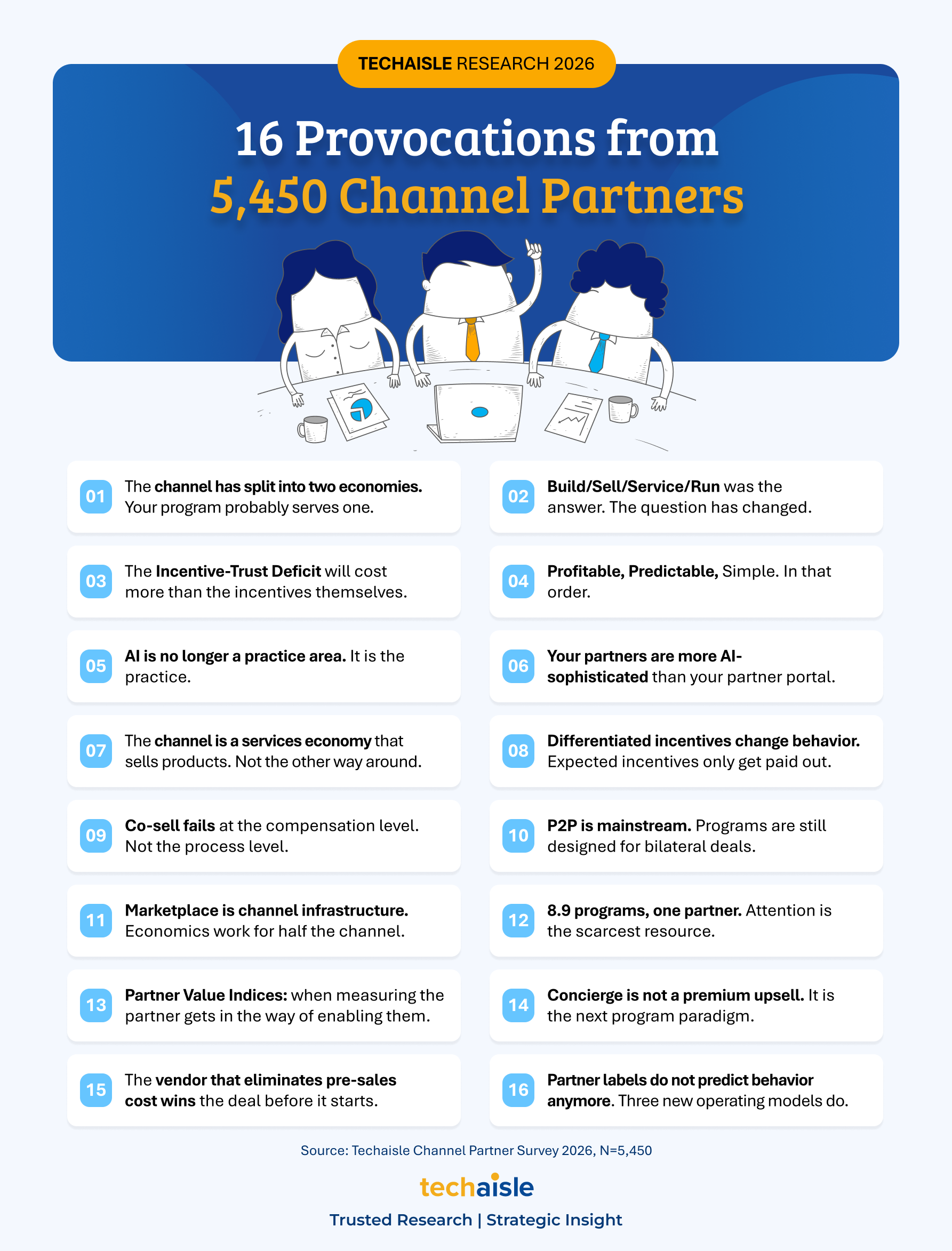
1. The channel has split into two economies. Your program probably serves one.
The vendor running one program across both economies has not simplified. They have chosen one economy and abandoned the other. You need both. You cannot serve both with one incentive model, one tier structure, one co-sell motion, or one measurement framework.
2. Build/Sell/Service/Run was the answer. The question has changed.
The vendor that creates the first program track designed for orchestration partners, recognizing value across Build, Sell, Service, and Run simultaneously rather than forcing a primary motion, will attract the most economically valuable partners in the ecosystem. Everyone else will be retrofitting in 24 months.
3. The Incentive-Trust Deficit will cost more than the incentives themselves.
The vendor that wins the next decade of loyalty will offer certainty: transparent scoring, annual-only changes, real-time earnings visibility, and metric alignment with how partners actually make money. Trust is becoming the incentive.
4. Profitable, Predictable, Simple. In that order.
Partners do not choose vendors for vision. They choose for reliability. The boring vendor with clear, stable, profitable rules wins over the innovative vendor who reshapes every quarter. Program stability is not a constraint on innovation. It is itself the innovation most partners are asking for.
5. AI is no longer a practice area. It is the practice.
Stop treating AI enablement as a certification track. Make AI the backbone of every program element. Incentives, co-sell, blueprints, concierge, measurement. The vendor whose entire program is AI-native outperforms the one bolting an AI module onto existing structure.
6. Your partners are more AI-sophisticated than your partner portal.
Make the partner portal your most compelling AI product. AI-powered intelligent search. Predictive lead routing. Automated administrative friction removal. Personalized recommendations tied to specialization. If you cannot impress your own partners, customers will not believe your AI story either.
7. The channel is a services economy that sells products. Not the other way around.
If your program rewards the first sale the most, you are funding the least profitable moment in your partners' economics. They know it. Their CFOs know it. The vendor that re-architects program math around services economics will see the most profitable partners shift dollars in their direction.
8. Differentiated incentives change behavior. Expected incentives only get paid out.
You will not win commitment through better margin. Every vendor offers margin. You win by funding the full lifecycle. This is not a marginal program reform. It is a redistribution of the program dollar that signals to partners which vendor understands how the channel actually makes money.
9. Co-sell fails at the compensation level. Not the process level.
The vendor that achieves this simple structural change will outperform those investing in platforms, tools, and processes that compensated reps still will not use.
10. P2P is mainstream. Programs are still designed for bilateral deals.
This is not a future requirement. It is a structural gap in current programs that vendors can close with explicit policy changes.
11. Marketplace is channel infrastructure. Economics work for half the channel.
The vendor that solves marketplace economics for services partners unlocks the half of the ecosystem currently locked out of the channel infrastructure everyone is required to use.
12. 8.9 programs, one partner. Attention is the scarcest resource.
Every rule you add costs attention that flows to competitors who demand less. Treat partner attention as a fixed resource you must compete for, not an unlimited budget you can spend.
13. Partner Value Indices: when measuring the partner gets in the way of enabling them.
A simpler system partners trust outperforms a sophisticated one they resent. The measurement should illuminate, not obscure.
14. Concierge is not a premium upsell. It is the next program paradigm.
The vendor that launches concierge as the new standard of partner support will reset expectations for the entire industry. Partners will then evaluate every other vendor against that benchmark.
15. The vendor that eliminates pre-sales cost wins the deal before it starts.
The vendor whose solutions can be quoted without custom architecture transforms the economics of every partner deal from hours of design to minutes of configuration. That is structural advantage no marketing budget can replicate.
16. Partner labels do not predict behavior anymore. Three new operating models do.
None of these three models maps cleanly to VAR, SI, MSP, ISV, or Consultant. That is the point. The vendor program that still routes partners by traditional label is sorting on the wrong axis. Techaisle's 2026 channel research identifies three: Data Orchestrator, Business Process Architect, and AI Outcome Underwriter. The vendors that build tracks for these models will fund the partners actually growing. Everyone else will fund the labels and miss the firms.
When you subscribe to the blog, we will send you an e-mail when there are new updates on the site so you wouldn't miss them.