Hardware spend rises as companies scale, which runs against the assumption that software absorbs everything. Techaisle's study of 3,980 organizations shows where the laptop-and-dongle room breaks, what replaces it, and why the equipment is no longer there to show a meeting but to record one.
Almost every company starts the same way. A screen, a dongle, and whoever's laptop is in the room. It costs nothing, and it works well enough, which is why nobody ever decided to do it. Then, somewhere between the fifth room and the fiftieth, companies stop, and in Techaisle's survey of 3,980 organizations, the switch shows up in spending. USB add-ons for the laptop-and-dongle room fall to 18% at the top of the midmarket, the lowest priority on the whole list, while AI cameras, ceiling microphones, and sensors climb fast. The question worth answering is what they buy instead, and what forced the switch.
What the midmarket is actually buying
All-in-one video bars lead at every size, from 42% in the smallest firms to 56% in the largest, because they work the moment you switch them on. That part is expected. The next tier of spending is less so. AI cameras that follow the speaker rise from 21% to 43%. Ceiling microphone arrays climb from 12% to 37%. Sensors that count people and track how a room is used go from 8% to 31%.
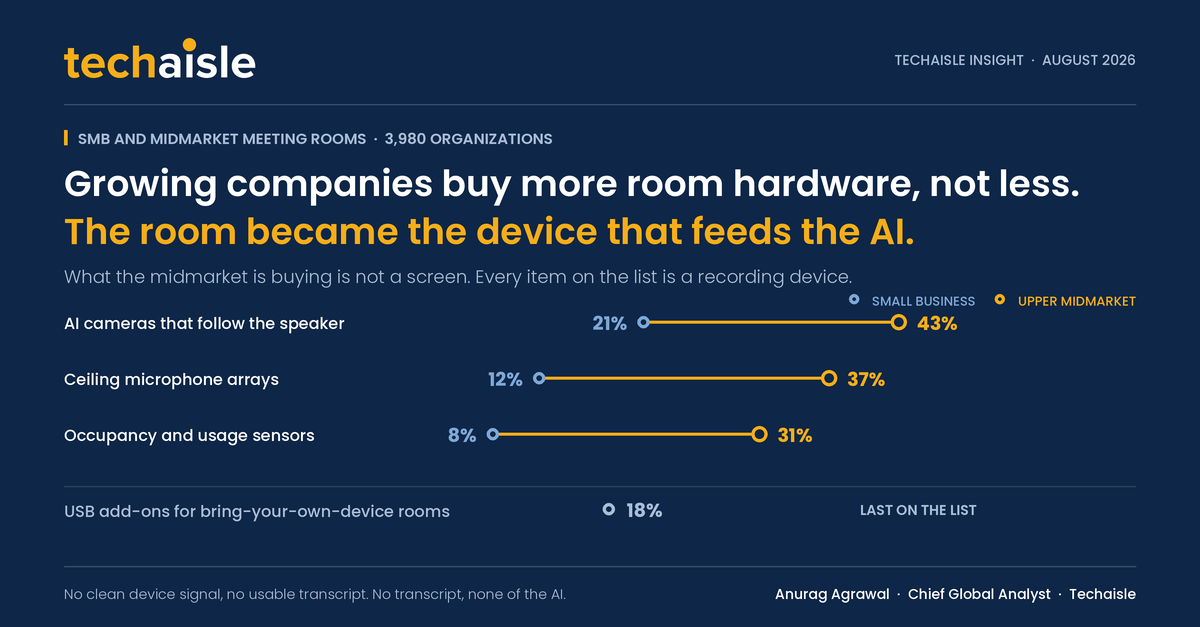
Each one is a recording device. The camera produces a clean video signal. The microphone captures clear, separated audio. The sensor counts who is in the room. The room is being wired to capture what happens inside it, not just to show the people who dialed in.
That matters because of what sits on top. The feature the whole market wants is a meeting that turns itself into action, where the conversation writes itself into the CRM, creates the ticket, and sends the follow-up. It only works if the recording is clean at the source, because a poor transcript produces a wrong record. The camera and the microphone decide whether every AI feature above them works.
There is a second effect that pulls in more buyers. Once a room has sensors, how the space gets used stops being a meeting detail and becomes a real-estate question. A company running dozens or hundreds of rooms can finally see which sit empty and how much space it is paying for and not using. That brings facilities and finance into a purchase that used to belong to IT alone.
What breaks the laptop-and-dongle room
The switch happens at a certain size rather than at a certain date. One room running on a laptop is a workaround. Fifty rooms running on laptops is an unmanaged estate with no consistent audio, no security posture, and no usage data. Two things break down at that scale.
The first is recording quality. You cannot run reliable room intelligence on whatever camera and microphone a visitor happened to bring. As soon as a company wants the meeting to produce a record it can act on, the equipment in the room becomes the limiting factor.
The second is security, and it shows up hard in the data. The risk of bring-your-own-device jumps from the bottom of the concern list to a top-three midmarket worry, from 12% to 37%. A company-owned, standardized room can be locked down and audited. A room built around a visitor's laptop cannot.
The same logic is visible outside the meeting room. Among frontline workers, the fastest-growing group in the market, the pattern repeats. Personal phones for frontline communication fall from 52% to 38%, company-issued devices take the top spot at 55%, and rugged handhelds and wearables climb from 10% to 25%. In the room and on the floor alike, devices move from personal and borrowed to company-owned and managed, for the same two reasons: you cannot secure what you do not own, and you cannot get clean data from equipment you did not provide.
How many rooms, and how often they buy
The number of rooms grows fast with company size. The smallest firms run 1 to 5 rooms. In the upper midmarket, 73% of companies manage more than 50, and nearly a third manage more than 200. This is not a story about a few showcase rooms.
The budget behavior should hold a hardware maker's attention. The share of companies planning no device spend at all collapses from 20% to between 3% and 6% as they grow, so at the top of the midmarket, buying devices is a permanent line item rather than a one-time project. More than half of the upper midmarket plans to spend more. The market is also steady rather than boom-and-bust: most firms plan to hold spending about the same, with few planning cuts, which signals a predictable refresh cycle.
Standardizing does not mean locking into one brand. The common midmarket model is a main vendor plus a backup, running at 33% to 40%, with full single-vendor standardization climbing from 17% to 27%. Buyers want consistency with room for the odd specialized device.
What this means for a devices and rooms vendor
The account becomes addressable at the point where the laptop-and-dongle room stops working. A company still adding its first few rooms will not buy a sensor suite. A company past that point will not go back to dongles.
So sell two different product lines. Small businesses want plug-and-play video bars that work on day one. The midmarket wants AI cameras, sensors, and the scheduling and management software to run dozens or hundreds of rooms. Selling the simple bar into a 200-room company underserves it. Selling the full sensor suite into a 3-room firm overprices it.
Then win the standard. In a company running fifty rooms, the second room is not a fresh decision; it matches the first. Whoever supplies the initial deployment usually supplies every room added afterward, and the console that manages them becomes the system of record for the room estate. Over a few years, that console accumulates the usage history, the utilization data, and the support relationship. That is the lock-in, and it holds better than a software subscription because it is bolted to a wall.
The room is the most defensible position in the communications stack. It is underrated because the industry learned to treat room hardware as a commodity back when the equipment really was just a screen, and that assumption is now expensive.
Techaisle · SMB & Midmarket Communications & Collaboration Adoption Trends Study (N=3,980)