For two decades, the bargain between AWS and the software industry was clear and mutually profitable. AWS sold the substrate - compute, storage, networking, databases, and models. Independent software vendors built the experiences that customers actually used. The hyperscaler captured rent on the floor; the ISVs captured rent on the ceiling. Every Salesforce, Workday, ServiceNow, Epic, and SAP transaction reinforced this division of labor.
That traditional division of labor evolved on April 28. With the rebranding of Amazon Connect into a four-product family, the launch of Amazon Quick on desktop, and the introduction of Managed Agents for OpenAI within Amazon Bedrock, AWS has recognized that infrastructure alone cannot solve the enterprise activation void. AWS is no longer just selling the picks and shovels; it is delivering the fully operational gold mine. And it is doing so armed with a moat that no SaaS incumbent - not Salesforce, not Workday, not Epic - can replicate: the operational record of having actually run the world’s largest retailer, logistics network, hiring engine, and primary care practice. This is not a feature update. It is a category change.

The End of the Substrate Bargain
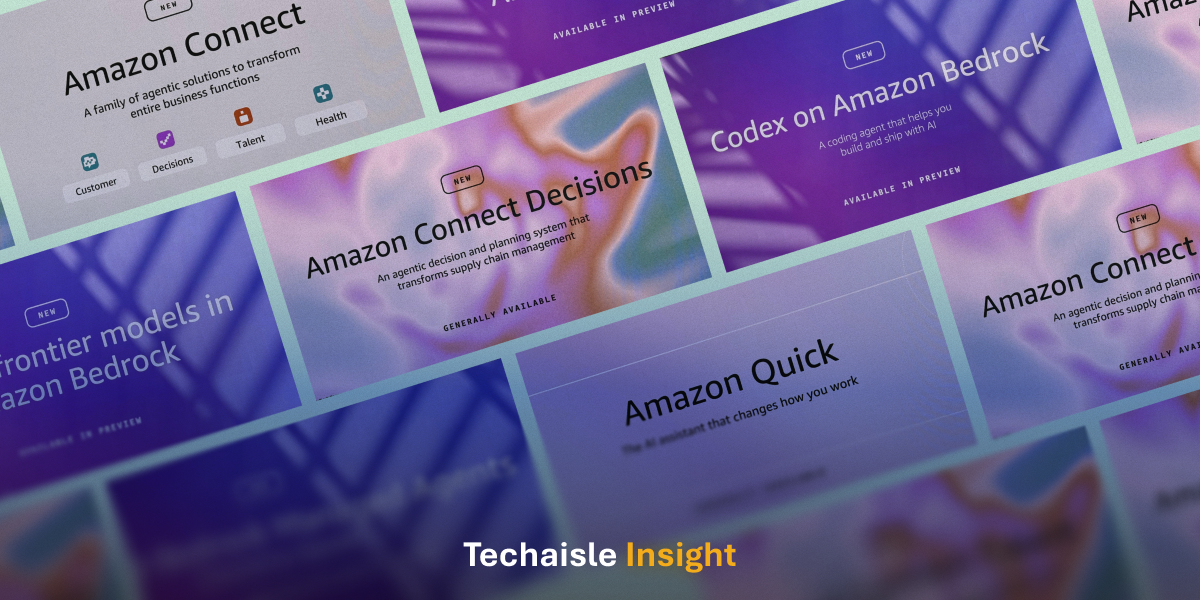
The most strategically loaded announcement of the day was the one that sounded most boring: Amazon Connect is now a family of agentic solutions to transform entire business functions. The Connect family will house four products - Customer AI (the original contact-center solution), Decisions (supply chain), Talent (hiring), and Health (clinical workflow) - each one introducing an agentic alternative to established SaaS categories.
The signal is unmistakable in what AWS chose to absorb rather than build new. Connect Decisions is, in the words of AWS’s own product leadership, the next generation of AWS Supply Chain - the prior product has been “essentially assimilated.” This is the same playbook AWS used with Amazon SageMaker AI: take a workbench tool, rebuild it as an industrial system, reposition the category. Except this time, the categories are not “machine learning platforms.” They are enterprise hiring, clinical documentation, and supply chain planning. The vendors who traditionally own those categories are publicly traded SaaS giants, and AWS has just fundamentally altered their competitive baseline. While AWS will undoubtedly continue to host and support these competitors, the philosophical shift is unambiguous: the application layer is no longer a passive ecosystem. It is an active arena for AWS innovation.
Operational Provenance: The New Moat
The puzzle is how AWS plans to differentiate in domains where incumbents have spent twenty years building depth. The answer is something I will call operational provenance - the strategic asset of having actually run the workflow at planetary scale, and being able to encode that experience into software.
Workday sells HR software; Amazon scaled to over a million employees during the pandemic, surviving the largest mass-hiring event in private-sector history. Epic sells clinical documentation; Amazon’s One Medical has now run more than a million ambient-documentation visits through the system that became Connect Health. SAP sells supply chain software; Amazon built a global fulfillment network from five centers to several hundred specialized facilities, learning hard and expensive lessons at every step. The Connect family is Amazon turning its own thirty-year operations laboratory into a commercial product line.
This matters because of where the market actually is. Per Techaisle’s recent quantitative study of 4,381 SMB and Midmarket firms across 24 countries, 34% of these organizations have been experimenting with AI for longer than six months without operationalizing it. We have called this state pilot purgatory - and the cause is not a shortage of models. It is a shortage of workflow templates that actually work. When a midmarket retailer asks, “How should I run my supply chain with AI?”, a model cannot answer that. A vendor that has actually run a supply chain at scale can. Operational provenance is the bridge from prompt to production - an asset that AWS has, that no SaaS incumbent does, and that no model provider can manufacture.
Humorphism and the Activation Void
Buried inside the Connect family announcement is a design philosophy AWS calls humorphism - the principle of building tools optimized for human-AI cooperation rather than retrofitting interfaces designed around old constraints. It deserves attention because it is the first credible naming of a problem we have been documenting for two years at Techaisle: most enterprise software was designed for an era when humans were the bottleneck. When agents become the doer, the interface, the change management process, and the user training architecture all need to be rebuilt.
Our research has called this gap the Activation Void - the chasm between AI deployment and AI productivity. Even among firms that have deployed AI, fewer than half can point to measurable productivity outcomes. The reason is that bolting an LLM onto a 1990s ERP screen does not produce agentic value; it produces a slightly faster way to fill out the same form.
Humorphism is the design answer to the activation void, and the Quick desktop application demonstrates this most clearly. Quick is not a feature glued onto an existing tool; it is a new surface that observes how a marketing manager actually works - across Slack, Outlook, brand guidelines, ad-spend dashboards, and Instagram analytics - and intervenes proactively. The shift from “tool the user opens” to “context graph that watches the user” is the actual product innovation. Per Techaisle’s partner trends data, demand for AI/ML Management services from partners now sits at 53%, and the partners winning are not the ones reselling licenses; they are the ones building the human-agent collaboration patterns that customers cannot articulate themselves.
The Two-Front Strategy: OpenAI on Bedrock
The most strategically intriguing announcement was Amazon Bedrock Managed Agents for OpenAI. This fully managed service runs OpenAI’s frontier models, with their proprietary agentic harness, inside AWS infrastructure, governed by AWS guardrails. On the surface, this looks like another model added to the Bedrock catalog. In substance, it is a masterclass in architectural gravity. AWS has designed a dual-engine strategy where its infrastructure remains the essential economic and operational foundation, regardless of the customer's chosen route. The partnership lands in three specific pieces, each addressing a distinct buyer.
The first is OpenAI’s frontier models - including GPT-5.5 - now accessible through the existing Bedrock APIs with unified security, governance, and cost controls. The genuine analytical implication is not model availability; it is the consolidation of the procurement surface. A CFO can now see GPT-5.5 spend, Claude spend, and Nova spend in a single console with a single set of policy controls. The multi-model billing fragmentation that has been a quiet tax on every enterprise AI program is being eliminated in one move. The enterprise that yesterday needed three vendor relationships to run a multi-model agent stack now needs one.
The second is Codex on Amazon Bedrock - OpenAI’s coding agent, already used by more than four million developers weekly. This is a highly pragmatic strategic maneuver by AWS: rather than insist that all serious developer agentic work happens through its native Kiro agent, AWS is actively channeling the massive OpenAI developer base directly into Bedrock spend. Enterprise developer tools are about to consolidate onto whichever runtime owns the governance and cost layer, and AWS has clearly decided it will be the host for Codex rather than ceding those high-value workloads. For CIOs, the practical consequence is straightforward: the developer tool budget is no longer a separate line item from the cloud budget. They are merging.
The third is Amazon Bedrock Managed Agents powered by OpenAI - a tightly coupled stack of OpenAI models, OpenAI’s proprietary agentic harness, and AWS infrastructure, optimized for customers who value speed-to-production over architectural flexibility. This is the deepest commercial bet in the bundle. It monetizes the enterprise that does not want to choose between open and proprietary architectures, and because AWS owns more layers of the stack in this configuration, it is also the highest-yield workload class for AWS itself. Expect the largest regulated-industry deployments to land here first, because this is the only configuration where the enterprise can deploy frontier models with a clean compliance story out of the box.
OpenAI’s ChatGPT often serves as the default consumer AI assistant, while Amazon Quick is engineered specifically for the enterprise workspace. By simultaneously launching its own application and making AWS the most secure, governed venue for running OpenAI’s technology, AWS is offering unprecedented architectural optionality. If a customer prioritizes a turnkey, out-of-the-box experience, they can deploy Quick. If they prefer to build custom agents using OpenAI’s frontier models, AWS provides the Bedrock environment, the AgentCore runtime, and the Cedar-based policy enforcement to make those models enterprise-ready. In either scenario, AWS seamlessly underpins the innovation.
What makes this palatable to risk-averse enterprises is the deterministic safety layer. AWS does not put guardrails inside the model - it wraps them around the model, using the Cedar policy language and automated reasoning to enforce safety with mathematical precision in milliseconds. For a chief risk officer, this is the unlock. An OpenAI model running inside Bedrock is not policed by OpenAI’s training; it is policed by formal logic that the customer’s own security team writes and audits. The non-deterministic engine is contained inside a deterministic cage. This is the only architecture that makes regulated industries deployable - and it is one that pure-play model providers, however capable, cannot offer.
Underpinning all of this is a compute-economics argument that pure-play model providers cannot match. Inference, not licensing, is becoming the dominant cost line in any serious agentic deployment, and AWS’s custom silicon - specifically Trainium’s price-performance profile - means that running OpenAI’s frontier models inside Bedrock is not merely more governed; it is materially cheaper per inference at scale. The implication for the CFO is direct: the enterprise that optimized its model licensing line item but ignored the underlying compute substrate will be the one with budget surprises in 2027, when agent inference loops, not single-shot prompts, dominate consumption. AWS has now stacked three independent reasons to anchor an agentic workload on Bedrock - model choice, deterministic safety, and purpose-built silicon. Any one of them is sufficient to close a deal. Together they compound. There is a quieter strategic consequence worth naming as well. This configuration creates real margin pressure on Microsoft Azure’s OpenAI hosting position, because Azure runs OpenAI on commodity GPU infrastructure that does not benefit from equivalent vertical silicon integration. The OpenAI partnership announcement is, on one reading, AWS opening a second front against Microsoft inside Microsoft’s signature AI relationship.
Agents Are About to Become the Largest IAM Category
The least-discussed but most operationally consequential implication of the new architecture is its impact on identity management. AWS is signaling that agents will hold their own identities, not merely inherit them from human operators. There is now a hybrid model: user-initiated agents inherit the operator’s permissions, while autonomous, long-running agents carry their own credentials and authorization scopes. This sounds like an arcane plumbing detail. It is not. It is the most significant expansion of the IAM problem in fifteen years.
Consider the math. A typical midmarket enterprise manages identities for a few thousand human employees. In the agentic era, the same enterprise will need to manage identities for tens of thousands - eventually hundreds of thousands - of autonomous agents. Among early adopters in the mid-market, Techaisle now tracks 144 agents for every employee. In the SMB segment, the figure is 59 agents per employee, and rising. Every Frontier Agent, every Quick instance, and every Connect-family workflow agent is an identity holder that requires its own permission scope, audit trail, lifecycle, and rotation policy. The IAM team that yesterday managed a directory now manages a population. Identity and access management was already among the fastest-growing security spend categories among midmarket firms in our research; the agentic era will accelerate it further. Partners who can build Agent Identity Lifecycle Management practices for fleets of digital workers will own a service line that did not exist eighteen months ago. The CIOs who treat agents as a new identity class today will avoid the security debt their peers are about to accumulate.
Skills as Markdown: The Quiet Commoditization of Prompt Engineering
One of the most under-appreciated signals from the announcement is that “skills” - the units of capability that AWS, Anthropic, and OpenAI are all converging on - are simply markdown files, and they are not proprietary across vendors. A skill written for Anthropic’s Claude works in OpenAI’s Codex. The skill format itself has become a portable artifact, and prompt engineering, as a paid discipline, is being quietly absorbed into the workflow layer.
This is profound for two reasons. First, the differentiator in the agentic era is no longer who can write the cleverest prompt; it is who has the workflow knowledge to know what skill is worth writing in the first place. Second, it shifts where the partner ecosystem creates value. Skills - codified, transferable workflows layered on top of the platform - are the new IP asset class. The partner who builds a “Healthcare Revenue Cycle Skill Library” that runs equivalently across Bedrock, Codex, and any other agent runtime owns a portable, defensible, high-margin asset. Prompt engineers were artisans; skill authors are publishers.
Techaisle Take: The Reabsorption Era
The April 28 announcements mark the start of what I call the Application Reabsorption Era - the period in which hyperscalers, having spent two decades enabling the SaaS economy, begin selectively reclaiming its highest-value layers. AWS will not absorb everything. It will absorb the workflows where its own operational data gives it an unfair advantage. That list is longer than most SaaS executives are prepared to acknowledge.
A point of nuance is worth surfacing before going further. Asked directly about the “SaaSpocalypse” thesis at the April 28 event, Matt Garman pushed back on the more dramatic versions of it, and the pushback was warranted. Incumbent SaaS providers carry genuinely deep domain expertise, large installed customer bases, and rich proprietary data - advantages that are not easily displaced. Garman cited Salesforce’s recent introduction of a headless version of its platform as the right kind of incumbent response: leaning into the agentic shift rather than defending the legacy interface, and recognizing that in an agent-first world, the differentiated value lives in workflows and data rather than the UI. That is a credible playbook, and other category leaders will run versions of it. The analyst question, then, is not whether incumbents survive - they will - but where the forward growth in each category gets captured. Reabsorption does not require any incumbent to fail; it requires only that a meaningful share of the next dollar of category spend be allocated to the hyperscaler stack rather than to a legacy seat license. That is a narrower claim, and one that the announcements support directly.
For the Enterprise, the strategic action is uncomfortable but clear. The CIO who renewed a multi-year SaaS contract last quarter for a domain where Amazon now offers a Connect-family equivalent has potentially locked themselves into deterministic legacy debt in an agentic world. Procurement teams should treat every Connect-family launch as a forced re-evaluation, not a vendor expansion conversation. Run the math on Connect Decisions versus your current supply-chain platform. Run it on Connect Talent versus your HCM. The answer may not be migration today, but it is no longer “do nothing.”
For the Midmarket and SMB, this is the most powerful democratization we have seen in a decade. The hiring engine that Amazon used to scale through the pandemic (now capable of conducting asynchronous AI-led interviews), the supply chain logic that runs the world’s largest retailer, and the clinical documentation workflow that powers One Medical (operating directly inside existing EHRs) are now accessible without the seven-figure license, the eighteen-month implementation, or the army of consultants. Connect Talent in particular addresses an acute pain point: SMBs cannot afford modern HCM software, and high-volume hiring is precisely where they cannot afford to be slow. The midmarket should treat the Connect family as the most aggressive enterprise-grade opportunity since the launch of public cloud itself.
But the true Trojan horse for midmarket democratization is the Go-To-Market motion behind Amazon Quick. By introducing social logins (Google, Apple, GitHub) to bypass traditional IT procurement, AWS is deploying a pure Product-Led Growth (PLG) approach that reduces time-to-experience to seconds. Furthermore, the inclusion of native data connectors for Google Workspace Suite, Zoom, M365 extensions, and - crucially for this segment - QuickBooks, instantly bridges the gap between frontier AI and the daily operational realities of a small business. Coupled with the new "Apps in Quick" feature, which allows business users to build custom team hubs using only natural language, AWS is not just democratizing the application layer; it is effectively turning every midmarket manager into an application developer without writing a single line of code.
For the Partner Ecosystem, the message requires the most calibration - and contains the most counterintuitive opportunity. The instinctive read is that AWS owning the application disintermediates the partner. The actual mechanic is more nuanced. Resale margin on Connect-family applications will compress; that part is straightforward. But the services surface around these applications widens because Connect Decisions, Talent, and Health all require vertical configuration, integration with legacy systems, change management practices, governance frameworks, and the operational literacy needed to embed agents into actual business processes. Techaisle data is unambiguous on the underlying economics: partners earn approximately a 30% margin on cloud resale but command 70% margins on managed services and IP-based offerings, and services revenue has now crossed product resale revenue. The partner who treats the Connect family as a product to resell will be squeezed. The partner who treats it as a foundation to build on - wrapping it with vertical IP, agent identity governance, and outcome-based managed services - will see margin profile improve, not deteriorate. The Reabsorption Era rewards those who own the outcome, not those who broker the SKU.
In the final analysis, the April 28 announcements are an admission that the agentic era will not be won at the model layer or the infrastructure layer alone. It will be won by the company that can deliver an actual outcome - a hire made, a patient documented, a stockout prevented - as a single, governed, operationally-provenanced product. AWS has decided it will be that company. The cloud was the ground floor of the digital economy. The agentic application is the top floor. For the first time in twenty years, the same company, Amazon AWS, is offering to sell you both.