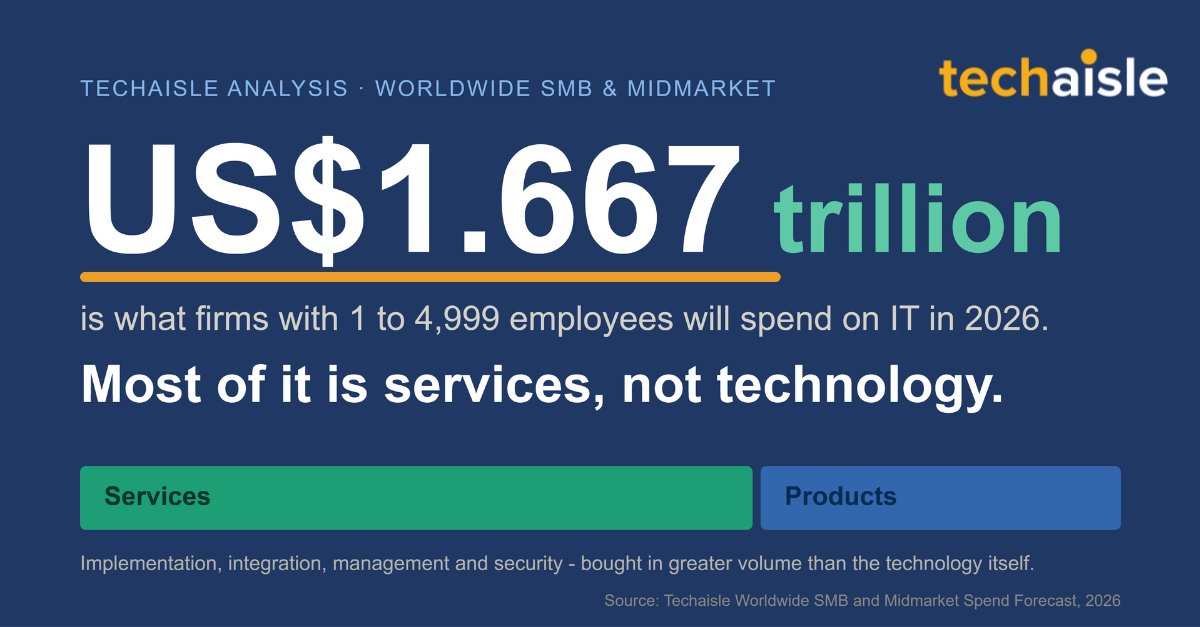
Worldwide IT spending by firms with 1 to 4,999 employees will reach US$1.667 trillion in 2026, excluding communication services, and the majority of it will go to IT services rather than to technology products. A market of that size, spread across every economy and every industry, sets the direction for commercial IT rather than following it. These firms are now spending more on the implementation, integration, management, and security of technology than on the technology itself, and the margin between the two is wide and widening.
That composition is the product of two forces working against each other. AI is pulling money up and forward, into software, infrastructure, and services that were not in the budget a year ago. Cost is pulling the other way, as component inflation, tighter budgets, and a higher cost of capital are pushing firms to defer what they can and to rent what they cannot. That second force is the quieter one, and it explains the tilt toward services better than any capability argument does. Buying an outcome instead of an asset moves cost from the balance sheet to the income statement, and it moves operational risk from the firm to the provider. In a year of expensive capital and unforgiving threats, that trade is worth paying for, which is why the money is moving toward services even where the technology itself is cheap.
Within services, the mix has shifted. Maintenance, support, and break-fix, the labor of keeping systems alive, once defined the SMB services market. The money is now concentrating in consulting, integration, and putting AI into production. Transformation work has overtaken recurring management, and it is not close.
Partner programs have not moved with it. Every major vendor built its channel around the recurring line, certifying, tiering, and rewarding partners for competence in the managed and resale motions that now hold the slower-growing, smaller half of the market. The partners capturing the transformation spend, the integrators and born-in-AI services firms, sit outside the program entirely. The fastest-growing services dollars are accruing to partners the program was never built to count.
The same misalignment runs through product spend. Products are the minority of the market, and software is the largest of the three product categories. Software is also the line AI is rewriting fastest. Generative AI entered this market segment as software, embedded in tools these firms already licensed, and it spread without a new hire or a new server. These firms are not training or fine-tuning their own models. They are buying AI already built into the software they license, packaged into something a midmarket firm can use unmodified. That packaging is where the spend is going. The software dollar is accruing to the vendor that turns the model and the raw platform into a finished product, and the hyperscaler is reaching the SMB through an ISV that has abstracted the platform away. The money is landing with whoever owns the packaging layer, and it is not the one who owns the model.
AI is doing the same thing to infrastructure. Data center spending is rising, and AI is the reason. What triggers an infrastructure purchase has changed: firms are adding capacity to run AI workloads rather than replacing equipment that has aged out. Upper-midmarket firms are building controlled on-premises AI infrastructure for local inference, and they are doing it for two specific reasons: data sovereignty for regulated workloads that cannot leave the building, and the cost point at which running a steady AI workload on owned hardware beats renting it by the token. By bringing this infrastructure in-house, these firms are constructing a private Corporate Brain, a permanent store of their own operational data that stays under their control. Both conditions are concentrated in the upper midmarket and almost nowhere below it. The smallest firms meet neither, and they are making the opposite choice, renting inference through their partners. The category is now a question of who builds AI capacity and who borrows it.
Devices are the one category where spending is rising for reasons the SMB buyer did not choose. They are the most cyclical line in the market, and 2026 is distorting them in a way the raw number hides. A memory shortage is driving component costs sharply higher, and the increase is landing hardest at the low end of the range, where small and midmarket firms buy. So device spending is rising even as unit shipments are falling. SMBs are paying more for each machine and buying fewer of them, and the spending line is climbing while the market underneath it is contracting. This is a price shock being absorbed. Demand has not returned. The same shortage is taxing the on-premises AI build at the same time, because the memory that inflates the price of a laptop inflates the price of a server, and a single supply constraint ends up squeezing both categories from opposite ends of the budget. And the deferral only postpones the cost. Every refresh a firm holds back in 2026 will release later, into a different machine than the one it put off, the AI PC, whose higher price buys capability.
A small firm and a midmarket firm handle that deferral differently, and the difference runs deeper than devices. The SMB and midmarket segments are not acting on a single spectrum. Small firms are putting most of a modest services budget into a single line, fully managed services, buying the outcome whole because they have neither the wish nor the staff to operate anything themselves. The midmarket is breaking that concentration apart. Its services spending is fragmenting across consulting, integration, outsourcing, and project work, because these firms are buying the expertise to run systems themselves. The change is a break. There is no smooth middle where the managed services share thins by degrees. A partner built to sell the whole outcome to a small firm does not glide upmarket into selling expertise, and one built for midmarket project work does not scale down into turnkey delivery. That boundary is where the spend splits into two different buying motions, and a single partner tier stretched across both captures one of them at a time, never both.
Security is pulling toward operated service harder than any other category, moving from product to service faster than the rest of the market. Security services now rival security software in size, and dedicated security hardware is retreating as network-delivered protection is replacing the appliance. That shift is moving where the dollar is spent and who spends it. When protection is bought as a running outcome, the spend moves from the end firm to the provider operating on its behalf, the MSSP or the managed-security partner, who buys the product and resells it as a service. The operated model runs furthest ahead here for one reason: the cost of falling behind is measured in breaches.
Security has a second property that matters more at the small end: it is the one spending line firms cannot defer, and that inverts the segment logic. Everywhere else, the small firm postpones. In security, it cannot, because protection has turned from a discretionary purchase into a required one, forced by cyber-insurance terms and compliance rules. A firm that will postpone a hardware refresh indefinitely cannot postpone the control its insurer now demands as a condition of coverage. That single compulsion makes security spending the most dependable line in the smallest segment, the one budget that holds when the rest are cut.
AI runs underneath every one of these categories. It sits inside the software these firms license, the services their partners deliver, and the infrastructure a few of them build. Generative AI spending will grow 62% in 2026, faster than any other line in this market. Half of it will go to software and 42% to services, which is the whole story in two numbers. Almost none of that money is creating a new line in the budget. It is flowing through channels that already exist, into the software these firms already license and the partners they already pay, which is why AI in this market looks less like a new category and more like a repricing of everything already being bought. The real building is concentrating in the midmarket, the one tier with the data and the use cases to turn AI from a feature into a system.
The smallest movement in the market is the one that matters most. Agents that execute work rather than assist a user will take 14% of generative AI spending. The share matters more than the amount. At that point, AI is no longer a tool a person operates. It is an operation that runs on its own, and that changes how the spend is metered. A seat-based product is priced by how many people use it. An agent is priced by how much work it does, which breaks the per-seat model that every software vendor in this market is built on. As autonomous agents execute more workflows, the consumption meter spins faster, creating an unpredictable financial risk. This shift will force the midmarket to adopt a rigorous AI-nomics discipline to prevent consumption bill shock. Buying an outcome means managing its costs. Agentic spend is concentrating where the operational data to automate real work already lives, in the midmarket and above. Every other shift in this market is a matter of degree. This one is a matter of kind.
The US$1.667 trillion is changing what it buys. The same dollars that once bought hardware, licenses, and the labor to maintain them are now buying integration, operated services, and AI delivered inside software. Services hold the majority and are still taking share. Products are the minority, and within them the spend is moving toward whatever is bundled, operated, or delivered as an outcome. The midmarket is building, the small firm is consuming, and both are spending more on being served than on being supplied. That is the shape of the US$1.667 trillion in 2026. It is counted as technology spending. It is bought as a service.